 Deep Insight Think Deeper. See Clearer
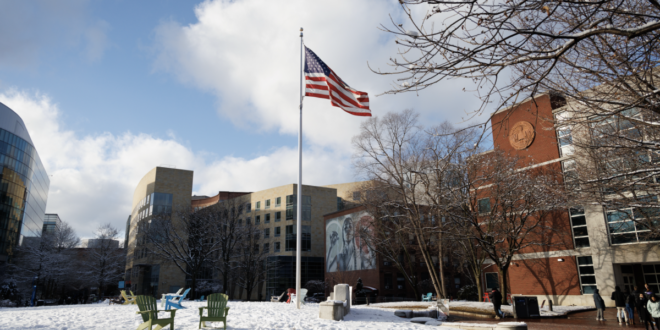
At Northeastern’s first faculty senate meeting of the spring semester, held Jan. 28, faculty and administration discussed faculty concerns, a new master’s program, the consolidation of experiential learning studies, artificial intelligence and enrollment statistics.
Faculty concerns on budget cuts
Louise Walker, a professor and faculty senator from the College of Social Sciences and Humanities, or CSSH, raised concerns about budget cuts during the Q&A following a report by Provost Beth Winkelstein. Walker said that reductions to the Dialogue of Civilizations program are affecting students’ ability to meet graduation requirements.
“One example that I heard just recently is that a high proportion of Dialogues of Civilizations have been cut,” Walker said. “I think it’s somewhere in the neighborhood of 40%.”
She expressed concerns that the cuts are causing students to stress about meeting their graduation requirements and how the cuts will impact the university’s ability to fulfill its “core mission.”
The CSSH mission focuses on experiential academics, with a focus on global study, whether that be completing a semester abroad or participating in a Dialogues of Civilizations summer program.
“Students in programs like international affairs need an international experience to graduate,” she said. “[They are] not getting what they paid for or what they were promised.”
During the Q&A segment of the meeting with Winkelstein, Walker requested greater transparency and clarity from the university about its financial decision-making and budget allocation processes.
“The request I’ve been getting from colleagues that I share with them is, can we please have a presentation on the budget allocation process and some creative thinking for getting out of this core mission-critical situation that’s being reported across my college, CSSH?” she said.
In 2025, CSSH saw massive cuts to the department’s discretionary budgets of up to 80%, according to a department-wide email sent by CSSH Associate Dean for Administration and Finance Jim Rollins last July. The reductions come in the wake of the Trump administration’s federal funding cuts to research budgets and his attacks on higher education across the nation.
Global experiential learning
Chancellor and Senior Vice President of Learning Ken Henderson, who was in attendance, responded to earlier faculty concerns regarding changes to the global experiential learning programs, including consolidations to Dialogue of Civilization programs and the removal of some of the specific locations. He explained that changes were made to consolidate programs across colleges in order to improve academic fit and scale, not to limit student opportunities.
The Dialogue approval process is overseen by the Global Experience Office, which handles safety and logistics, and Northeastern’s individual colleges, which retain control over academic content, Henderson said.
Henderson reiterated that Northeastern remains No. 1 in experiential learning. In the past academic year, over 6,000 students participated in experiential learning projects, which includes Dialogues of Civilizations, research projects, service learning and entrepreneurship. There were over 5,900 students on co-op, more than 1,500 who participated in a Dialogue of Civilizations and over 1,300 enrolled in the N.U.in program.
New master’s program approved
Andrew Orr-Skirvin, clinical professor and director of the pharmaceutical industry fellowship program, introduced a proposal to add a master’s degree in pharmaceutical and biomedical sciences in the Bouvé College of Health Sciences, or BCHS.
“The new master’s program takes into account a few important aspects of our students, one of which is that virtually all of our students focus on establishing or extending their careers in pharma biotech,” said Director of the BCHS’ Pharmaceutical Sciences Graduate Program David Janero.
The new program’s structure is designed to expand opportunities for students interested in establishing and advancing their careers in pharmaceutical biotechnology. Janero emphasized that the new program better aligns with the emerging demands of the pharmaceutical job industry.
“We want to make sure that the new curriculum and the new program reflects that, in terms of its contemporaneous nature, as well as meeting the requirements that the students may have in terms of their translational aspirations and the job market,” Janero said.
The proposed program combines four existing master’s programs into one unified degree with four concentration options. Each concentration requires 30 semester hours and includes core foundational courses to provide a common academic base for every student.
Janero explained that this common base will allow students “more flexibility with respect to electives,” offering that the increased customization options will allow students to more easily tailor their major to their career aspirations.
The motion to add the major was approved with 83% out of the 62 respondents voting in favor.
AI planning
During her provost report, Winkelstein explained the university’s current academic planning initiatives around “human agency in the age of AI.” She said the university plans to create six active focus groups, which include representatives from faculty, staff, students, alumni and strategic partners.
Both Winkelstein and Henderson said that integrating artificial intelligence into university operations is no longer optional, stressing that avoiding the issue could leave students unprepared for the workforce post-graduation.
“[AI] is not going anywhere else,” Henderson said. “It is something that we have to deal with, and it does mean fundamentally changing how we do our work.”
Henderson discussed increasing student engagement with artificial intelligence tools and the need for university guidance.
“Our latest data, internally, is 90% of our students, probably more now, are actually using generative AI in some shape, size or form,” he said.
According to the survey, undergraduate students’ top three concerns about AI included “real clarity about what’s allowed and what’s not allowed with AI,” “the need for AI education” and “changing and adapting the curriculum to be really relevant for today.”
Henderson emphasized that students want to be “AI ready” within their disciplines and need the university to provide leadership on how to achieve that goal.
“We don’t want the students to be ahead of us,” Henderson said, arguing that the curriculum should evolve to teach students how to ethically use generative AI in the industrial workforce. “We need to be ahead of them, we need to prepare them.”
New institutions and co-op initiative
Winkelstein also announced the university launched three new research institutes in 2025.
The Defense Industrial Base Institute, located on Northeastern’s Boston campus, will focus on strengthening U.S. defense manufacturing by connecting “government, industry, and higher ed to accelerate innovation, strengthen critical capabilities, and build the collaborative systems needed to meet today’s challenges—and prepare for what’s next.”
The Dublin Innovation Institute will foster new research partnerships in technology, sustainability, health and AI, serving as a pillar supporting the university’s research priorities and delivering global impact.
The Institute for Cognitive and Brain Health will research how lifestyle affects brain health to develop solutions that aim to improve global mental health outcomes. Through its examinations, the institute will identify societal problems and conduct research to address them.
Henderson also announced a new initiative: the co-op consultancy model. The model allows certain companies, such as Verizon and State Street, to sponsor a group of students to work on a joint co-op based on a specific long-term project over six months.
Enrollment and New York City Scholars
Winkelstein and Henderson went on to highlight Northeastern’s growing enrollment statistics. For the most recent cycle, the university received a record-breaking 105,190 applications. The yield rate for the Class of 2029 on the Boston campus was 47%, and early decision applicants have increased 600% since 2015.
Administrators positioned the enrollment metrics as evidence of rising competitiveness and increased student interest in Northeastern.
“Great credit to everyone on this call and all of your colleagues for building very attractive programs that are differentiated in a market which is extremely competitive and increasing in competitiveness. Again, we don’t take this for granted. We know we need to continue to work and innovate in this space, but we are in a very strong position as a function of our enrollments, both undergraduate and graduate,” Henderson said.
Northeastern’s New York City Scholars program, which launched this past fall, allows incoming students to complete their first undergraduate year in New York at Marymount Manhattan College before transitioning to the Boston campus in their second year. There are 273 students in the program in the spring 2026 semester.
Henderson highlighted that students are having a “phenomenal experience” and are participating in immersive activities.
The program has also been working to integrate co-op students in New York with first-year scholars to build community and campus life outside of Boston.
“We have already several hundred co-op students in New York … we’re inviting those co-op students to dinners with our first-year students, so that it gets them integrated into Northeastern,” he said. “It’s demystifying a lot of what the university and Boston experience will be like.”
Faculty growth
Lastly, Winkelstein reported rapid growth in faculty since 2016, with 93 new full-time faculty joining as of January, and continued growth in both tenure/tenure-track and non-tenure-track faculty over the last decade.