Fashion

Amazon appoints longtime AWS exec Peter DeSantis to lead new AI org

Amazon CEO Andy Jassy announced in a message to staff on Wednesday that longtime AWS executive Peter DeSantis will lead a new AI-focused organization within the company. This organization will be responsible for Amazon’s AI models like Nova, as well as silicon development and quantum computing, which help make AI tools faster and more efficient. DeSantis has spent 27 years …

Read More »

Zencoder drops Zenflow, a free AI orchestration tool that pits Claude against OpenAI’s models to catch coding errors

Zencoder, the Silicon Valley startup that builds AI-powered coding agents, released a free desktop application on Monday that it says will fundamentally change how software engineers interact with artificial intelligence — moving the industry beyond the freewheeling era of “vibe coding” toward a more disciplined, verifiable approach to AI-assisted development. The product, called Zenflow, introduces what the company describes as …

Read More »

6 Technical Skills That Make You a Senior Data Scientist

be honest. Writing code in 2025 is much easier than it was ten, or even five, years ago. We moved from Fortran to C to Python, each step lowering the effort needed to get something working. Now tools like Cursor and GitHub Copilot can write boilerplate, refactor functions, and improve coding pipelines from a few lines of natural language. At …

Read More »

Why most enterprise AI coding pilots underperform (Hint: It’s not the model)

Gen AI in software engineering has moved well beyond autocomplete. The emerging frontier is agentic coding: AI systems capable of planning changes, executing them across multiple steps and iterating based on feedback. Yet despite the excitement around “AI agents that code,” most enterprise deployments underperform. The limiting factor is no longer the model. It’s context: The structure, history and intent …

Read More »

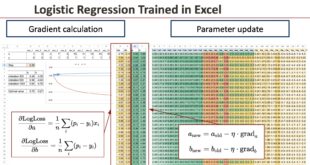
The Machine Learning “Advent Calendar” Day 12: Logistic Regression in Excel

Today’s model is Logistic Regression. If you already know this model, here is a question for you: Is Logistic Regression a regressor or a classifier? Well, this question is exactly like: Is a tomato a fruit or a vegetable? From a botanist’s viewpoint, a tomato is a fruit, because they look at structure: seeds, flowers, plant biology. From a cook’s …

Read More »

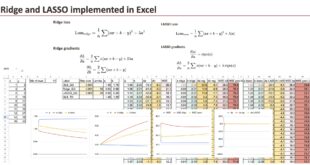
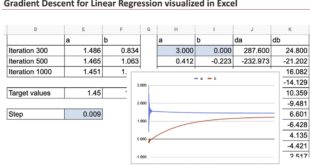
The Machine Learning “Advent Calendar” Day 11: Linear Regression in Excel

Regression, finally! For Day 11, I waited many days to present this model. It marks the beginning of a new journey in this “Advent Calendar“. Until now, we mostly looked at models based on distances, neighbors, or local density. As you may know, for tabular data, decision trees, especially ensembles of decision trees, are very performant. But starting today, we …

Read More »

Granular Ball Priors Enable General-Purpose Deep Fusion

[Submitted on 11 Apr 2025 (v1), last revised 9 Dec 2025 (this version, v4)] View a PDF of the paper titled Rethinking Few-Shot Image Fusion: Granular Ball Priors Enable General-Purpose Deep Fusion, by Minjie Deng and 5 other authors View PDF HTML (experimental) Abstract:In image fusion tasks, the absence of real fused images as priors forces most deep learning approaches …

Read More »

Clinical Interpretability of Deep Learning Segmentation Through Shapley-Derived Agreement and Uncertainty Metrics

arXiv:2512.07224v1 Announce Type: cross Abstract: Segmentation is the identification of anatomical regions of interest, such as organs, tissue, and lesions, serving as a fundamental task in computer-aided diagnosis in medical imaging. Although deep learning models have achieved remarkable performance in medical image segmentation, the need for explainability remains critical for ensuring their acceptance and integration in clinical practice, despite the …

Read More »

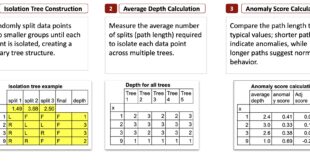
The Machine Learning “Advent Calendar” Day 8: Isolation Forest in Excel

with Decision Trees, both for Regression and Classification, we will continue to use the principle of Decision Trees today. And this time, we are in unsupervised learning, so there are no labels. The algorithm is called Isolation Forest, and the idea is to build many decision trees to form a forest. The principle is to detect anomalies by isolating them. …

Read More »